

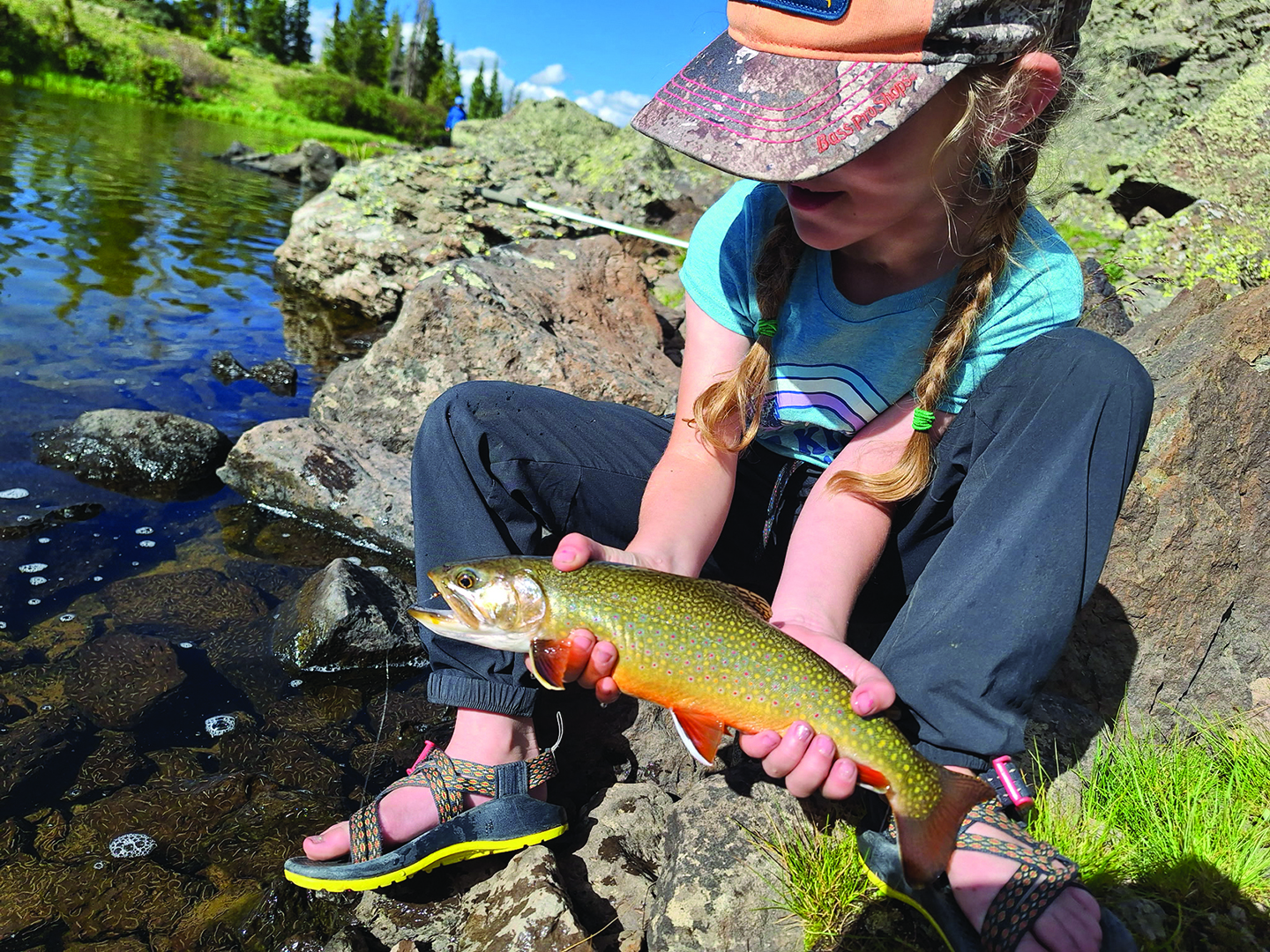
Wild Fish Wonder
By Aimee Eaton
Before we ever picked up fly rods, we caught fingerlings in a Tupperware. Wading through the shallows of a mountain creek, pants soaked above the knee, denim turned dark navy blue, we’d herd small schools of shimmering bodies toward the cutbank. Darting like rubberbands just released, thrusting our hands into the icy stream, scooping up water and life for our own eye-level examination. There wonder was born.
The tailgate is still down when Mae hooks her first fish. One of her brothers comes running up the bank to grab the net, while the other holds onto her waders and armchair quarterbacks the landing.
“Rod tip up, keep him out of the rocks, there’s a stick over there. You’re going to lose him!”
She ignores his advice, letting the trout swim wildly back and forth, bits of feather and fur visible in the corner of its mouth, confident in her hookset. Across the water, three seasoned fishermen sit in camp chairs, spinning rods gripped tight, watching the show.
By the time Mike and I finish closing up the truck, stashing the keys in the wheel well for safe keeping, both boys are knee deep in the water, the fish gently suspended in the submerged basket of the net. Mae remains perched above it all, dry and proud. She’s the youngest at six-years-old. The boys are eight and ten. This is not their first rodeo.
Mike reaches into the water and cradles the trout, a pretty little rainbow with black dots decorating its fins. He raises it from the water just enough to remove the fly from the corner of its mouth, the gills remaining submerged.
“Mae, you want to hold him? He’s your fish.”
We have taught the kids to handle all fish as minimally as possible, and when they do touch them to be gentle, quick and respectful. We also know that holding a wild fish, even for a moment, is getting to touch a bit of magic that is not always present in the day-to-day grind.
Mae declines, but both boys take a quick turn before we release the trout back to the water. We all reposition, spreading out down the bank, but before anyone else has wet a line, Mae has another fish on. She’s using a Tenkara rod, a simple, lightweight telescoping rod with no reel, just a bit of cord attached to the end of its 10-foot length. Tied to the cord is a short leader and tied to the leader a small dry fly meant to look like a grasshopper with yellow underwings. She casts the rod like she’s chopping wood, using two hands on the cork grip and swinging back and forth over her shoulder in hard, sharp motions. It is neither beautiful, nor skillful. Rather, we call it UBE – ugly but effective.
Over the next five minutes, Mae lands a dozen fish. After the fifth catch, a couple of men who’d been watching in disbelief pack up their chairs, their worms and their beers. They’ve had enough of our spectacle, but the kids are still going strong.
Fly fishing is funny. So often it’s associated with the elite, with tweed and single malt scotch. Or in its most recent rendition with high-end outdoor gear, $1,000 rods, and multiple Titan rod vaults placed securely on the roof of a fancy SUV. None of those things, however, will catch a fish. What will get the job done is being out there. Exploring. Creating a relationship with the water. Getting reacquainted with the wonder of catching those first wild fish.
At its root, fly fishing is about immersing in the experience. Fancy rods and waders are amazing, but too often we don’t try things because we’re afraid we’ll get it wrong, afraid we have the wrong gear, the wrong skills. Some of that might be true, and yet I’ll stand here and advocate starting anyway. Sure, you can book a guide, it’s a great way to get the basics down and there are some truly fantastic fly fishing professionals in the Gunnison Valley. But you can also just go to the river and figure it out on your own. Splash around. Tip your waders. Smile.
The perfect cast takes years of practice to master, but getting a fly in the water can be done in a moment. It doesn’t hurt, if like Mae, you’re just super fishy.
A FEW NOTES BEFORE TAKING TO THE WATER:
- Locals and visitors to the valley all need a valid Colorado fishing
license. They’re available online at cpw.state.co.us/fishing or at several of the local fly shops.
- Be smart taking kids fishing. Check the surroundings, make
sure they’re water safe, use common sense. Things can
happen fast.
- The Crested Butte and Gunnison areas provide some of the best
trout water in the state, but it’s important to know the regulations, areas for public access and how to properly handle fish.
A little education goes a long way in keeping the resource healthy.
- Lastly, we practice catch and release, pinch our barbs and don’t
fish if water temperatures are over 65 degrees. Those are ethical decisions based in science that reduce fish mortality.